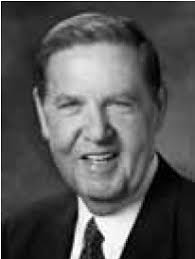
 “Let people repent. Let people grow. Believe that people can change and improve. Is that faith? Yes! Is that hope? Yes! Is it charity? Yes! Above all, it is charity, the pure love of Christ. If something is buried in the past, leave it buried. Don’t keep going back with your little sand pail and beach shovel to dig it up, wave it around, and then throw it at someone, saying, “Hey! Do you remember this?” Splat! . . . Such dwelling on past lives, including past mistakes, is just not right! It is not the gospel of Jesus Christ. . . . Forgive, and do that which is harder than to forgive: Forget. And when it comes to mind again, forget it again. You can remember just enough to avoid repeating the mistake, but then put the rest of it all on the dung heap Paul spoke of to those Philippians. Dismiss the destructive and keep dismissing it until the beauty of the Atonement of Christ has revealed to you your bright future and the bright future of your family and your friends and your neighbors. God doesn’t care nearly as much about where you have been as He does about where you are and, with His help, where you are willing to go. . . . Such is the wonder of faith and repentance and the miracle of the gospel of Jesus Christ.” - Jeffrey R. Holland, “Remember Lot’s Wife,” BYU Devotional address given on 13 January 2009
Tuesday, August 11, 2009
God doesn’t care nearly as much about where you have been as He does about where you are and, with His help, where you are willing to go.
“Let people repent. Let people grow. Believe that people can change and improve. Is that faith? Yes! Is that hope? Yes! Is it charity? Yes! Above all, it is charity, the pure love of Christ. If something is buried in the past, leave it buried. Don’t keep going back with your little sand pail and beach shovel to dig it up, wave it around, and then throw it at someone, saying, “Hey! Do you remember this?” Splat! . . . Such dwelling on past lives, including past mistakes, is just not right! It is not the gospel of Jesus Christ. . . . Forgive, and do that which is harder than to forgive: Forget. And when it comes to mind again, forget it again. You can remember just enough to avoid repeating the mistake, but then put the rest of it all on the dung heap Paul spoke of to those Philippians. Dismiss the destructive and keep dismissing it until the beauty of the Atonement of Christ has revealed to you your bright future and the bright future of your family and your friends and your neighbors. God doesn’t care nearly as much about where you have been as He does about where you are and, with His help, where you are willing to go. . . . Such is the wonder of faith and repentance and the miracle of the gospel of Jesus Christ.” - Jeffrey R. Holland, “Remember Lot’s Wife,” BYU Devotional address given on 13 January 2009

Thursday, August 6, 2009
Adversity and Affliction
 “I have seen the remorse and despair in the lives of men who, in the
hour of trial, have cursed God and died spiritually. And I have seen
people rise to great heights from what seemed to be unbearable
burdens. Finally, I have sought the Lord in my own extremities and
learned for myself that my soul has made its greatest growth as I have
been driven to my knees by adversity and affliction."
- Marion G. Romney, Improvement Era, Dec. 1969, 69
Godly Whisperings
“In the pain, the agony, and the heroic endeavors of life, we pass through a refiner’s fire, and the insignificant and the unimportant in our lives can melt away like dross and make our faith bright, intact, and strong. … It is part of the purging toll exacted of some to become acquainted with God. In the agonies of life, we seem to listen betterto the faint, godly whisperings of the Divine Shepherd.” 
- James E. Faust, Ensign, May 1979, 53
Saturday, June 27, 2009
Look Forward with an Eye of Faith
 For some time I have known that chapters 5 and 32 in Alma deal with the same subject—faith. Until my reading last year, however, I had failed to notice how carefully the two sermons were tailored to their respective audiences. Alma’s listeners in chapter 5 were Church members in Zarahemla (see Alma 5:2). This city was the headquarters of the Church, and one may assume that the members knew the doctrine. In contrast, the listeners in chapter 32 were the poverty-stricken Zoramites who had been forced out of the synagogues by the rich. The people in this part of the land had drifted far from the truth (see Alma 31:12–17). Although the poor were humble and wanted to learn, they were investigators needing to be taught gospel fundamentals.
 Alma’s sermon in chapter 5 to the members in Zarahemla was deep and complex. The series of questions he posed assumed familiarity with the doctrine and experience with the Holy Ghost. Otherwise, the questions would have had little meaning and been difficult to answer. The purpose of the questions was to prompt those members in Zarahemla to review and renew their faith in the Lord and His redemptive powers. Listen to the questions (see Alma 5:14–15):
• Have you spiritually been born of God?
• Have you received His image in your countenances?
• Have you experienced this mighty change in your hearts?
• Do you exercise faith in the redemption of Him who created you?
• Do you look forward with an eye of faith and view this mortal body raised in immortality to stand before God to be judged according to the deeds that have been done in the mortal body?
To appreciate and answer these questions, one must know about and believe in the atoning sacrifice of the Lord Jesus Christ, have experienced a cleansing by water and by fire, have tasted the fruits of the Holy Spirit, and believe in the literal resurrection of the physical body. This was not a sermon for initiates but for well-grounded members of the Church.
In contrast, Alma taught the Zoramite investigators the rudiments of faith—how faith in Christ begins and then grows. The sermon in chapter 32 is so clear concerning the faith-building process that missionaries use it today to teach investigators how they may develop a testimony. The process begins with a “desire to believe.” An individual must then plant the seed—which is the word of God—in his or her heart by searching the scriptures, listening to the words of the prophets, praying and asking for a confirmation of gospel truths, going to church, and obeying the commandments. The result, Alma said, will be a swelling in one’s bosom, an enlightenment of the mind, and warm feelings in the heart (see Alma 32:28). These are the beginning of a testimony—and the seed is good. Anyone with a sincere desire to know can obtain a testimony by following Alma’s teachings in chapter 32.
After explaining the initial faith-building process, Alma continued with a question in chapter 32: “After ye have tasted this light is your knowledge perfect?” (Alma 32:35). No—the process has just begun (see Alma 32:36). The seed has grown but is still only a seedling. Alma explained that if one continued faithful, the seedling would grow into a tree. What tree? The tree of life! (see Alma 32:41). This tree is a symbol of God’s love for His children expressed through the condescension and atoning sacrifice of His Son (see 1 Nephi 11:9–33; John 3:16).
Alma taught the Zoramites that when the tree was deep within their souls, they would feast upon its fruit and not hunger or thirst (see Alma 32:42–43). In other words, they would have experienced spiritual rebirth—the mighty change of heart—and the tree deep within their soul would produce God’s image in their countenances. - Merrill J. Bateman, Look Forward with an Eye of Faith, BYU fireside address given on 5 March 2006
Saturday, June 20, 2009
Husbands, first and foremost...
 “ ‘Husbands, love your wives, even as Christ also loved the church’ (Eph. 5:25). In latter-day revelation the Lord speaks again of this obligation. He said, ‘Thou shalt love thy wife with all thy heart, and shalt cleave unto her and none else’ (D&C 42:22). To my knowledge there is only one other thing in all scripture that we are commanded to love with all our hearts, and that is God Himself. Think what that means! This kind of love can be shown for your wives in so many ways. First and foremost, nothing except God Himself takes priority over your wife in your life—not work, not recreation, not hobbies. Your wife is your precious, eternal helpmate—your companion.”
- Ezra Taft Benson, “To the Fathers in Israel,” Ensign, Nov 1987, 48
Tuesday, June 16, 2009
Patience
 "Patience is the capacity to endure delay, trouble, opposition, or suffering without becoming angry, frustrated, or anxious. It is the ability to do God’s will and accept His timing. When you are patient, you hold up under pressure and are able to face adversity calmly and hopefully. Patience is related to hope and faith—you must wait for the Lord’s promised blessings to be fulfilled."
- from Preach My Gospel
Subscribe to:
Posts (Atom)
